Civil Society Groups Join Forces to Address Pollution from Energy Industries

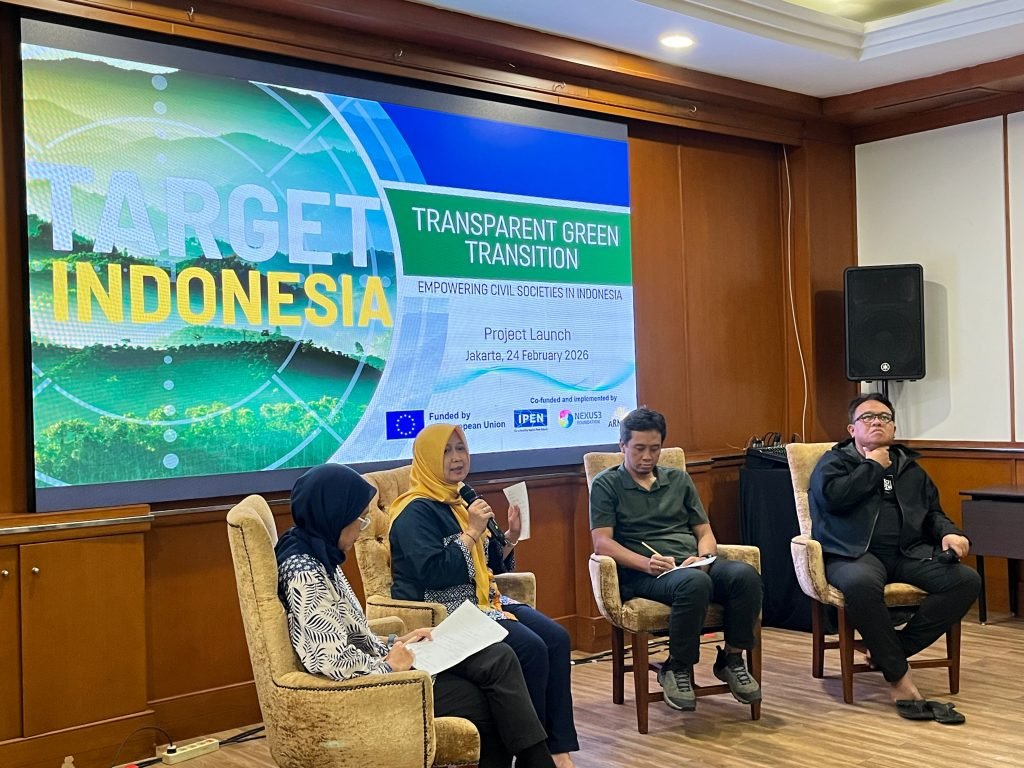
Jakarta, 25 February 2026 – Over 50 members of environmental civil society organisations (CSOs), academia, and Indonesian regulators gathered on February 24 in Jakarta to support Indonesia’s transition to a just, green economy in the energy and metallurgy sectors. While accounting for 11.9% of GDP in 2023, these sectors are also major sources of pollution and toxic chemical releases, posing serious risks to the environment and human health. In 2019, air pollution was the third-leading risk factor for death among children under five in Indonesia, underscoring the urgent need for action.
Between 2026 and 2030, the European Union (EU) will support six projects to advance Indonesia’s civil society’s empowerment in the just green transition, gender equality, and women’s empowerment. One of these projects is Project Transparent Green Transition Indonesia (TARGET): Empowering CSOs in Indonesia, which aims to strengthen CSOs to generate robust, scientific evidence that directly supports more effective advocacy and stronger policy implementation.
Around the world, the EU works to promote the sustainable development of our societies, our environment, and our economies as well as to ensure that progress benefits everyone, not just a privileged few. The need for a just green transition has already been recognised in many countries, including Indonesia.
“Sustainability in the energy transition and critical minerals supply chain is not just about the minerals we extract, but the lives we protect in the process. Our children’s and community’s health and the environment must not be sacrificed for financial gain," says Yuyun Ismawati of Nexus3. "Empowering our communities ensures that Indonesia’s contribution to the global green economy will be built on a foundation of health and environmental integrity.
The four-year project, funded by the European Union (EU) and implemented by the International Pollutants Elimination Network (IPEN) and its partners, Nexus3 Foundation and Arnika, will work closely with civil society organisations across Indonesia. The project will strengthen local capacity for pollution monitoring, enabling communities to identify, document, and respond to pollution threats. It will also provide targeted support to CSOs, local communities, and journalists to initiate data collection, increase public awareness, and expand access to reliable information, empowering advocacy, informing public debate, and guiding policy decisions and reforms.
Indonesia’s just and green transition is embodied in the country’s strategic documents, such as the National Long-Term Development Plan 2005-2025 (RPJPN), the National Energy Policy (KEN), the Just Energy Transition Partnership (JETP), the National Action Plan for Sustainable Development Goals (SDGs), and the National Masterplan for Industrial Development 2015-2035 (RIPIN, Rencana Induk Pengembangan Industri Nasional). Despite these policies and programs, information and data access on pollution sources remain limited.
“Public participation cannot be realised in the absence of complete information. “It is impossible to talk about the circular economy of hazardous waste when our environment is already severely damaged,” Ahmad Ashov Birry of Trend Asia stated during a panel discussion at the TARGET Project launch.
To strengthen the implementation of pollution monitoring and reporting, non-state actors need to be equipped with the knowledge and skills in scientific data collection, result interpretation, communication, and advocacy. By equipping CSOs and communities with the tools, data, and resources they need, Project TARGET aims not only to reduce pollution and toxic exposures but also to help secure a healthier, just, and more sustainable future for people across Indonesia.
"The green transition is not just about decarbonisation. We must also ensure that carbon and toxicity shifting do not occur. Strengthening waste management, hazardous waste management, and environmental data transparency are key to ensuring a truly equitable transition,” said Dr. I Made Wahyu Widyarsana, S.T., M.T., IPM, the Head of the Undergraduate Environmental Engineering Study Program of ITB.
Prof. Ir. Darmawati Darwis, S.Si., M.Si., Ph.D, of the Faculty of Mathemathics and Natural Sciences, Tadulako University added, “A green energy transition in Indonesia will only be truly 'green' if it is based on data integrity and justice for the affected regions. Central Sulawesi must not merely be an object of exploitation for the sake of global decarbonisation ambitions.
” Stronger collaboration between academia, government institutions, civil society organisations, and the media will not only elevate the quality of evidence and public discourse but also strengthen the capacity to transform knowledge into policy, oversight, and meaningful reform. TARGET Indonesia Project launch highly emphasises that the green transition is not merely a technical shift, but a governance transformation — one that requires transparency, accountability, and inclusive participation.
Redaksi Mayung Media
"Tim editorial Mayung Media."
Tulisan Lainnya:
Artikel Favorit Untuk Anda
Tour de Mawil 2026: Perjalanan Penuh Makna untuk Pelestarian Penyu di Pantai Mawil Sumbawa Barat